Baa: Ek Yoddha and the Walk Home: What a Father Gives, and What He Gets Back
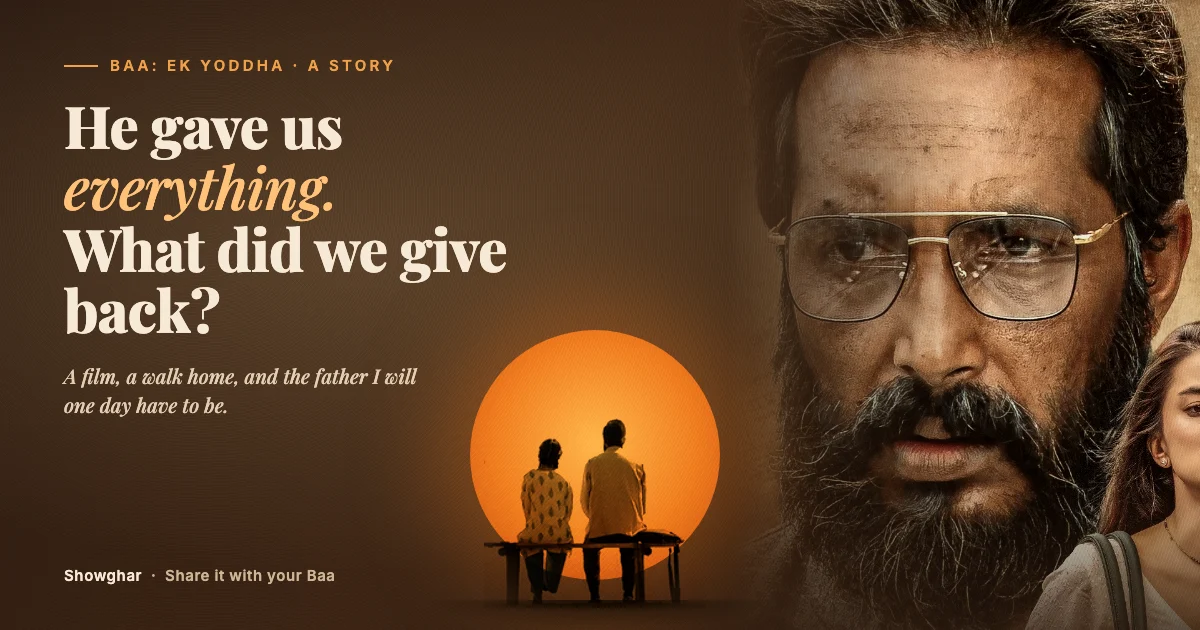
After an emotional film there is a moment when the lights come on and nobody wants to be the first to stand up. People look at phones they aren't really reading. Someone coughs to hide something else. That was the hall after Baa: Ek Yoddha.
I didn't cry out loud. Nepali sons rarely do. But on the walk home, the film kept walking beside me.
A father's work is mostly invisible
Directed by Hari Lamsal, the music composer making his debut as a director, *Baa: Ek Yoddha* is about the silent struggles, sacrifices and unconditional love of a father. The most important word there is *silent*.
In our homes, a father rarely announces what he does for us. He doesn't say, "I skipped my own new clothes this Dashain so your school fees could be paid." He says, "मलाई त चाहिँदैन." I don't need it.
As children we believe him. We think he really doesn't need anything. We think the old jacket is his favourite. We think he likes the burnt edge of the roti. We only understand much later that "I don't need it" was the most loving lie in the house.
What a father gives
The film made me count things I had never counted.
- His time. He traded his days for wages so we could have our own.
- His body. His back, his knees, and his eyes behind thick glasses like the ones on the poster, worn out a little more every year.
- His pride. He asked for loans, favours and one more month's time, then came home and behaved as if nothing had happened.
- His dreams. He put them off "until the children are settled", and many of them quietly expired while he waited.
None of this shows up on a bill. That is why we never think we owe anything.
What he gets back
This is where the film hurts, because the honest answer is: often, very little.
He gets a closed bedroom door. He gets "You don't understand, Baa." He gets phone calls that end quickly because we are busy. He gets a child who leaves for the city or another country. The paper texture on the poster carries an aeroplane and a Kathmandu postal stamp, and every Nepali family knows what that picture means.
And still he asks for almost nothing in return. "खाना खायौ?" Have you eaten? For many fathers, that one question is the entire repayment plan.
Yes, the film plays with your emotions
*Baa: Ek Yoddha* doesn't hide that it wants your tears. A composer knows exactly where to let a silence sit and where to let the music rise, and Hari Lamsal uses that knowledge without apology. Some people will call it manipulation.
I would call it a reminder. A film can only pull strings that are already there. It worked on me because every scene had a matching memory waiting for it.
The image I can't shake is the one on the banner: a father and a child on a bench, sitting a little apart, both looking in the same direction. That is how many of us are with our fathers. We sit side by side, but rarely face to face.
The walk home
I came out of the hall tired, the same way I come home from work every evening. On the way back I thought about my father coming home from his work: the sound of his slippers at the door, his keys always going in the same place, and the way he asked how everyone's day had gone before he said a word about his own.
Then it hit me. He was this tired every evening, for years, and he still had the energy to ask about my day. Most evenings I didn't look up from my phone long enough to ask about his.
One day I will be "Baa" too
I'm not a father yet. But one day someone will call me बा, and I will understand from the inside what I only watched from the outside.
When that day comes, I hope I do what my father did: give without keeping score. And I hope I do one thing he rarely could: say the silent things out loud. *I'm tired. I'm proud of you. I was scared too.*
That is what this film gave me. It wasn't just a story about one father. It was a mirror of the one I had, and a warning for the one I will become.
If this made you think of your Baa
Call him today. You don't need to say anything big. Just ask, "खाना खानुभयो?" Then listen for a little longer than usual.
And if you know someone who needs to make that call, share this with them.